Tell Me Again About the Time You Took Away the Guns
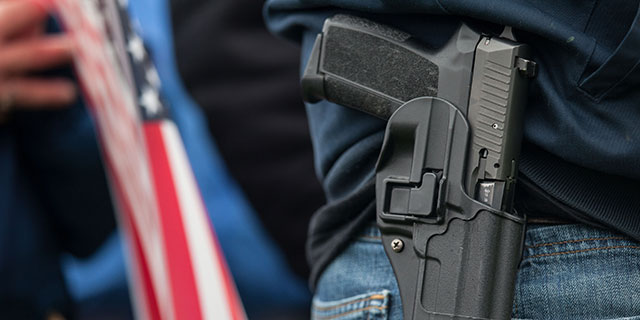
Every bit a nation, the U.Due south. has a deep and enduring connexion to guns. Integrated into the fabric of American gild since the land's primeval days, guns remain a indicate of pride for many Americans. Whether for hunting, sport shooting or personal protection, near gun owners count the correct to acquit arms as primal to their freedom. At the same time, the results of gun-related violence have shaken the nation, and debates over gun policy remain sharply polarized.
A new Pew Inquiry Centre survey attempts to better sympathise the circuitous relationship Americans have with guns and how that relationship intersects with their policy views.
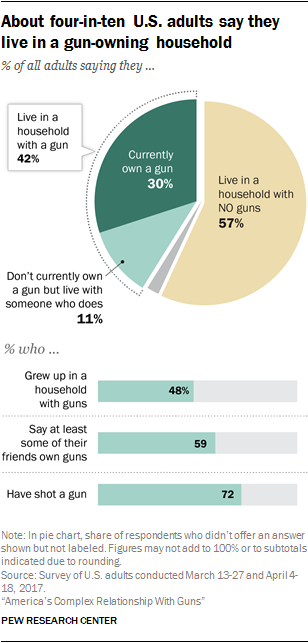
The survey finds that Americans have broad exposure to guns, whether they personally own one or non. At to the lowest degree two-thirds have lived in a household with a gun at some point in their lives. And roughly seven-in-x – including 55% of those who take never personally owned a gun – say they have fired a gun at some point. Today, iii-in-ten U.South. adults say they own a gun, and an additional 36% say that while they don't own one now, they might exist open to owning a gun in the future. A tertiary of adults say they don't currently ain a gun and can't meet themselves always doing so.
To be sure, experiences with guns aren't always positive: 44% of U.S. adults say they personally know someone who has been shot, either accidentally or intentionally, and about a quarter (23%) say they or someone in their family have been threatened or intimidated by someone using a gun. One-half see gun violence as a very big problem in the U.S. today, although gun owners and non-owners offer divergent views on this.
Gun owners and non-owners are likewise deeply divided on several gun policy proposals, but there is agreement on some restrictions, such every bit preventing those with mental illnesses and those on federal watch lists from buying guns. Amidst gun owners, there is a diverseness of views on gun policy, driven in big part by party affiliation.
The nationally representative survey of 3,930 U.S. adults, including 1,269 gun owners, was conducted March 13 to 27 and Apr 4 to 18, 2017, using the Pew Enquiry Center's American Trends Panel.ane Amidst the key findings:
The ties that bind gun owners to their firearms are oftentimes deep
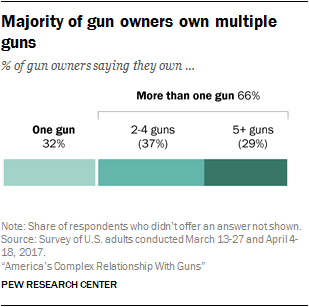
A majority of gun owners (66%) ain multiple firearms, and about three-quarters (73%) say they could never run across themselves non owning a gun.
Many American gun owners be in a social context where gun ownership is the norm. Roughly half of all gun owners (49%) say that all or well-nigh of their friends own guns. In stark dissimilarity, among those who don't own a gun, just ane-in-ten say that all or well-nigh of their friends own guns.
Experience with guns starts relatively early especially for those who grew up in a gun-owning household. Men who grew up in a household with guns and who have e'er shot a gun report that they first fired a gun when they were, on average, 12 years old. Among women who grew up in gun-owning households and who have ever shot a gun, the average age at which they first fired a gun is 17. Men tend to become gun owners at an earlier historic period than women: xix years sometime, on average, vs. 27 years old for women.
For about gun owners, owning a firearm is tied to their personal freedom
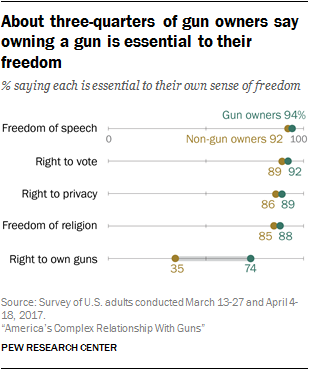
I key and defining characteristic of gun owners is the extent to which they associate the right to own guns with their ain personal sense of liberty – 74% of gun owners say this right is essential, compared with only 35% of non-gun owners who say the same.
While the correct to ain guns is highly valued by most gun owners, not all gun owners come across gun ownership the aforementioned fashion. Half of all gun owners say owning a gun is important to their overall identity – with 25% proverb this is very of import and some other 25% calling it somewhat important. Three-in-10 gun owners say owning a gun is not too important to their identity and twenty% say it's not at all important.
White men are peculiarly probable to be gun owners, but ownership crosses demographic boundaries
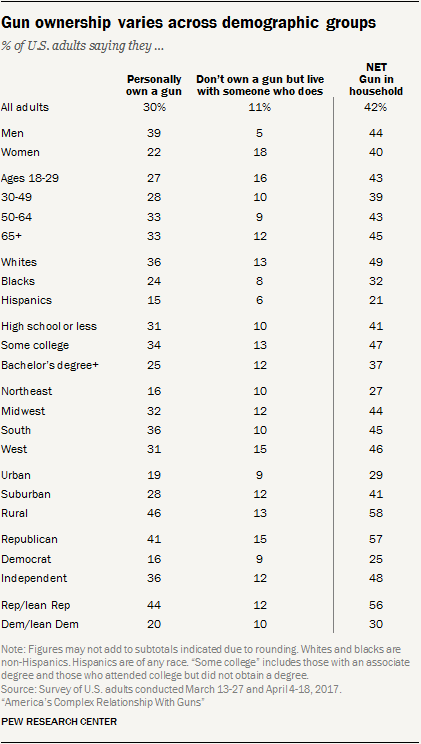
Well-nigh half of white men (48%) say they ain a gun. Past comparing, about a quarter of white women and nonwhite men (24% each) own guns, along with sixteen% of nonwhite women. ii There is also an education gap in gun ownership and that, too, is specially pronounced amongst whites: 41% of whites without a bachelor's caste are gun owners, compared with most a quarter of whites with at least a bachelor's degree (26%).
Geographically, gun buying is less concentrated in the Northeast than in other regions in the land, and in that location is a vast urban-rural divide across regions. Among adults who live in rural areas, 46% say they ain a gun. By comparison, 28% of adults who live in the suburbs and even fewer – xix% – in urban areas own a gun.
Male person gun owners tend to be more immersed in gun culture than their female counterparts
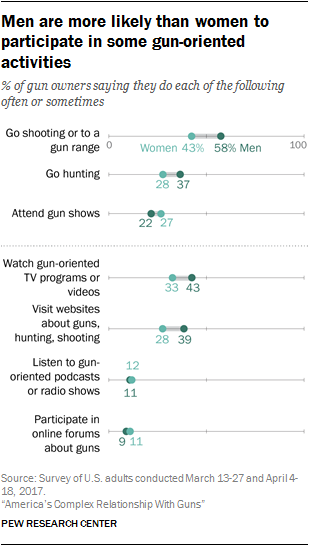
From hunting and shooting to visiting gun-related websites and watching gun-oriented TV programs, in that location are many activities bachelor to gun enthusiasts. About half of gun owners (52%) say they get shooting or to a gun range ofttimes or sometimes; 34% go hunting and 24% attend gun shows at to the lowest degree sometimes.
When it comes to gun-oriented media, roughly four-in-ten gun owners (39%) report that they at least sometimes watch TV shows and videos about guns, and 35% visit websites about guns, hunting or other shooting sports. Gun-related podcasts, radio shows and online discussion forums are less popular: About one-in-x gun owners say they mind to gun-oriented podcasts or radio shows (eleven%) or participate in online discussion forums about guns (10%) at to the lowest degree sometimes.
Male person gun owners are more than probable than women who own guns to engage in some of these activities. For case, 58% of men who own guns say they go shooting or to a gun range at to the lowest degree sometimes, compared with 43% of female gun owners. Men too chase at higher rates than women and watch more than gun-oriented TV shows or videos.
Consistent with their more frequent date in gun-related activities, male gun owners are more than socially connected to other gun owners than their female counterparts: 54% of men who own guns say all or most of their friends are also gun owners, while 40% of women say the same.
Protection tops the list of reasons for owning a gun
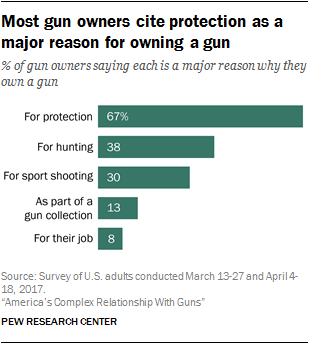
Ii-thirds of gun owners say protection is a major reason they own a gun. Past comparison, almost iv-in-x (38%) cite hunting equally a major reason and 3-in-x cite sport shooting, including target shooting, trap and skeet. Fewer betoken to a gun collection (13%) or to their job (viii%) as being cardinal to why they own a gun. To be sure, for many gun owners, these reasons overlap: 44% offering more than 1 major reason for owning a gun.
Roughly one-in-seven adults who own or take endemic a gun (15%) say they have fired or threatened to burn down a gun to defend themselves, their family or their possessions.
Regardless of the reasons for owning a gun, most gun owners don't think their having a firearm is public business, but they also aren't going out of their way to hibernate the fact that they own a gun. Eight-in-10 gun owners say they don't mind if other people know they own a gun, but they don't prepare out to tell them; 14% say they'd rather other people non know that they accept a firearm, and 6% actively do want others to know.
For many gun owners, a gun is frequently close at manus
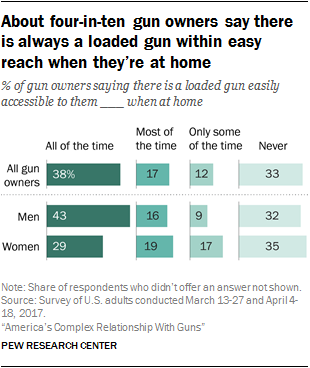
Roughly 4-in-10 gun owners (38%) say at that place is a gun that is both loaded and easily attainable to them all of the time when they're at abode. Men are specially likely to have a loaded gun at the ready: 43% of male gun owners vs. 29% of women who own guns say a loaded gun is always easily accessible.
Overall, about seven-in-10 gun owners say they ain a handgun or a pistol (72%), while 62% say they ain a rifle and 54% own a shotgun. Handguns are more than common amongst those who own a gun for protection.
Among those who ain a handgun, about one-in-four (26%) say they acquit their gun with them outside of their home all or well-nigh of the fourth dimension, a share that rises to 41% among those who think of their local customs as unsafe.
When it comes to gun safety in homes with children, there are some areas of agreement about fundamental precautions
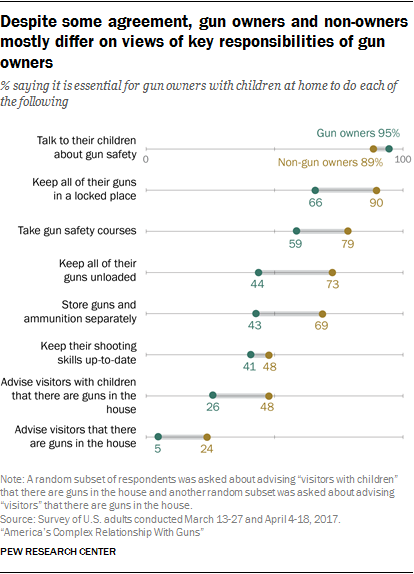
Of the many possible safety precautions gun owners could take when they live with children in the dwelling, three receive majority support from both not-owners and those who currently own a firearm. Nigh all gun owners (95%) believe that talking to children almost gun safety is essential, followed past 66% who say all guns should be kept in a locked place when at that place are children living in the abode, and 59% who say gun owners who are parents should take a gun safety course. Majorities of non-gun owners also say these are essential measures for gun owners with children in the home.
The majority of Americans who don't own guns feel it is also essential for gun owners with children living in the habitation to keep their guns unloaded and in a separate spot from the ammunition. Gun owners disagree. Majorities say these measures are either important just not essential or not of import, even in households with children.
When asked well-nigh their own habits, roughly half of gun owners with children under xviii living at home say all of the guns in their dwelling are kept in a locked identify (54%) and all are unloaded (53%).
However, many gun owners with children say at least some of their guns are kept unlocked and loaded. In fact, 30% of these gun owners say in that location is a gun that is both loaded and easily accessible to them all of the time when they're at home.
Americans who ain guns largely disagree with non-owners on gun policy, but some proposals have support from both groups
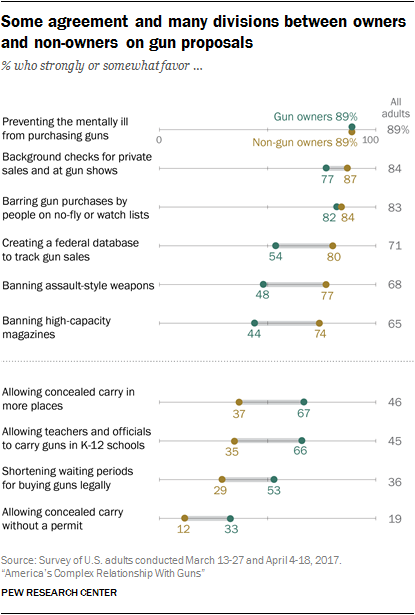
Solid majorities of both gun owners and non-owners favor limiting access to guns for people with mental illnesses and individuals who are on the federal no-fly or watch lists (82% or higher favor among each grouping). In addition, strong majorities favor background checks for private sales and at gun shows (77% amongst gun owners and 87% amidst not-owners).
The groups are more divided when it comes to iii other policy proposals: creating a federal database to track gun sales; banning assault-style weapons; and banning high-capacity magazines. Even so, significant shares of gun owners are open to these proposals. Roughly half of gun owners (54%) say they would favor creating a federal database, and 48% favor a ban on assault weapons. Some 44% of gun owners favor banning loftier-capacity magazines. Back up for these proposals is much college among non-gun owners, with most iii-quarters or more than saying they would back up each of these proposals.
At the same fourth dimension, majorities of gun owners favor proposals that would expand gun rights, such as allowing people to carry curtained guns in more places and allowing teachers and school officials to carry guns in K-12 schools – proposals that are each supported by simply nigh a 3rd of non-owners.
Even among gun owners, Republicans and Democrats don't see eye to middle on gun policy
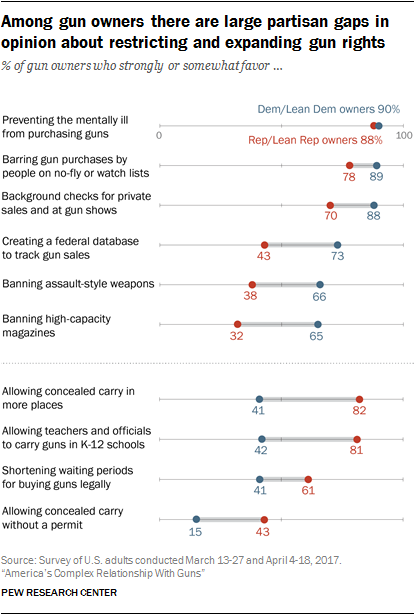
There is a partisan split up in gun ownership: More than 4-in-ten Republicans and Republican-leaning independents are gun owners (44%), compared with 20% of Democrats and independents who lean Democratic.
There is also a partisan split up on views of gun policy, and these differences remain even after controlling for gun ownership. For instance, Republican gun owners are much more resistant than Autonomous gun owners to creating a database to track gun sales and banning assault-way weapons and high-chapters magazines. On the flip side, Republicans are also more open up to proposals that would expand gun rights. A prime example: 82% of Republican gun owners favor expanding concealed deport laws to more places, compared with 41% of their Democratic counterparts.
Republican gun owners are about twice as likely as Democratic gun owners to say owning a gun is essential to their freedom (91% vs. 43%), and in that location are likewise behavioral differences between these two groups. For example, Republican handgun owners are more likely than their Democratic counterparts to say they acquit their gun with them, even if only some of the fourth dimension (63% vs. 45%). Fully 55% of Democrats who own a handgun say they never carry.
At the most basic level, gun owners and not-owners disagree on the extent to which gun violence is a problem in the U.Due south.
Half of Americans describe gun violence every bit a very big problem in the United states of america, but the perceptions of gun owners and those who don't own guns differ considerably. While a bulk of those who practise not own guns (59%) come across gun violence as a major problem in the land today, a third of adults who own guns say this is a very big trouble. Democrats and Republicans also offer unlike assessments, with Democrats far more likely to describe gun violence equally a very large problem, and the partisan split remains when decision-making for gun ownership.
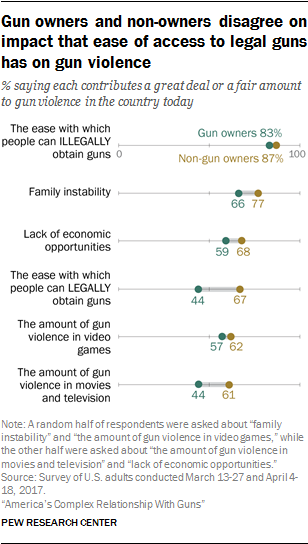
Americans see many factors as playing a role in gun violence in the country today. Fully 86% say the ease with which people can illegally obtain guns contributes to gun violence a great deal or a off-white corporeality; more than half say the same near family unit instability (74%), lack of economical opportunities (65%), the amount of gun violence in video games (60%), the ease with which people can legally obtain guns (threescore%), and the amount of gun violence in movies and telly (55%).
Gun owners and not-owners akin signal to the ease with which people can illegally obtain guns as a major correspondent to gun violence in the U.S., simply opinions diverge when it comes to guns obtained legally. Ii-thirds of not-gun owners see the ease with which people can legally obtain guns as contributing at to the lowest degree a fair amount to gun violence; less than one-half (44%) of gun owners share this view.
It follows that not-gun owners are much more than probable than gun owners to say further restricting legal gun sales would issue in fewer mass shootings (56% vs. 29%); and non-gun owners are too more than probable to say an increase in gun ownership would lead to more crime overall (44% vs. 13%). For their part, 54% of gun owners say in that location would be less offense if more people owned guns, and 33% say it wouldn't make much difference.
About a quarter of U.S. adults say they or someone in their family unit have been threatened or intimidated by someone using a gun
Many Americans (44%) say they personally know someone who has been shot, either accidentally or intentionally. This is particularly mutual among black adults, 57% of whom say they know someone who has been shot; about four-in-ten whites (43%) and Hispanics (42%) say the aforementioned.
College share of gun owners (51%) than non-owners (xl%) written report that they know someone who has been shot, either accidentally or intentionally.
Separately, about a quarter of Americans (23%) – including roughly equal shares of gun owners and non-owners – say they or someone in their family accept been threatened or intimidated by someone using a gun. Once again, blacks are more likely than whites to say they have had this experience: About a third of blacks (32%) say they or someone in their family take been threatened or intimidated past someone with a gun, compared with 20% of whites. About a quarter of Hispanics (24%) say this has happened to them or to someone else in their family unit.
Roughly one-in-five gun owners belongs to the NRA
Overall, 19% of all U.Due south. gun owners say they vest to the NRA. Republican and Republican-leaning gun owners are twice every bit likely as Autonomous and Democratic-leaning gun owners to say they belong to the NRA (24% vs. 11%). And, amidst Republicans, conservatives have significantly higher rates of membership – 28% vs. 17% of moderate or liberal Republicans.
The public is divided when it comes to the amount of influence the NRA has over guns laws in the U.S. While 44% of all adults say the NRA has too much influence over gun legislation, 40% say it has the right amount of influence. Relatively few (15%) say the NRA has too fiddling influence.
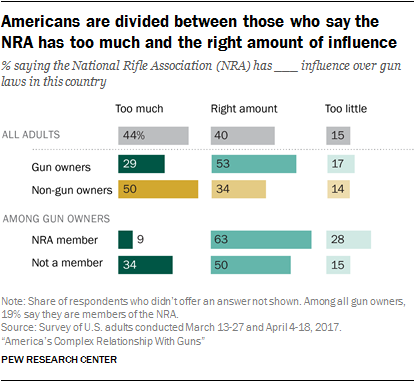
For their part, NRA members are largely satisfied with the corporeality of influence the system has over gun laws in the U.S. About six-in-x (63%) say the NRA has the right amount of influence and 28% say information technology has too little influence. Only ix% of NRA members say the system has too much influence over gun laws. Among non-gun owners, 50% view the NRA equally too influential.
Gun owners are more likely than not-gun owners to take ever contacted a public official to express their opinion on gun policy. About one-in-five gun owners (21%) say they have done this, compared with 12% of non-gun owners.
The remainder of this written report examines in greater detail the public's experiences with guns equally well every bit views on gun policies. Chapter 1 looks at the demographics of gun ownership and the reasons people own guns. It also explores early on experiences with guns, such as growing upward in a gun-owning household and participating in hunting or sport shooting. Affiliate 2 focuses on the role guns have in the daily life of gun owners, including whether they bear a gun outside their abode, how often they engage in gun-related activities or consume gun-oriented media, and their social ties to other gun owners. Information technology too looks at negative experiences some people accept had with guns. Chapter 3 examines the public'due south views on the responsibilities of gun ownership, with an accent on the differences betwixt what gun owners and non-owners consider essential safe measures for gun owners to follow. Chapter 4 explores what Americans see as contributing factors to gun violence. Chapter 5 focuses on the public'south views on policy proposals to restrict or expand admission to guns.
Unless otherwise specified, "guns" refers to firearms and non to airsoft guns, such as paintball, BB or pellet guns.
"Gun owners" are those who say they personally own ane or more guns. "Non-owners who live in a gun-owning household" are those who say they exercise not personally ain any guns, but someone else in their household does.
Those who did not grow up with guns in the habitation includes those who say, as far as they know, there were never whatever guns in their household when they were growing up or they are non certain if there were guns in their household when they were growing upward.
Those who are said to have children in the household or at dwelling house are those who are a parent or guardian to a child younger than 18 who lives in their household.
References to college graduates or people with a higher degree comprise those with a available's degree or more than. "Some college" refers to those with a ii-twelvemonth degree or those who attended college merely did not obtain a degree. "High schoolhouse" refers to those who have attained a high schoolhouse diploma or its equivalent, such as a General Education Development (GED) certificate.
References to whites and blacks include only those who are non-Hispanic and place as only one race. Hispanics are of whatever race.
All references to party amalgamation, excluding one reference in affiliate 1, include those who lean toward that party: Republicans include those who say they lean toward the Republican Political party and Democrats include those who say they lean toward the Democratic Party.
References to adults who live in an urban, suburban or rural surface area are based on an assay that takes into account the density of the surface area where they alive based on their accost or the location of their telephone number or their Zilch lawmaking if they didn't provide an accost. For a more than detailed caption of how community blazon was coded, see the Methodology department of the study.
Source: https://www.pewresearch.org/social-trends/2017/06/22/americas-complex-relationship-with-guns/
0 Response to "Tell Me Again About the Time You Took Away the Guns"
Post a Comment