When Was the Work of Art in the Age of Mechanical Reproduction Published
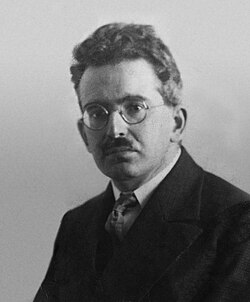
In "The Work of Art in the Age of Mechanical Reproduction" (1935), Walter Benjamin addresses the artistic and cultural, social, economical, and political functions of art in a capitalist society.
"The Work of Art in the Age of Mechanical Reproduction" (1935), past Walter Benjamin, is an essay of cultural criticism which proposes and explains that mechanical reproduction devalues the aura (uniqueness) of an objet d'art.[one] That in the age of mechanical reproduction and the absence of traditional and ritualistic value, the production of art would be inherently based upon the praxis of politics. Written during the Nazi régime (1933–1945) in Federal republic of germany, Benjamin's essay presents a theory of art that is "useful for the formulation of revolutionary demands in the politics of art" in a mass-civilization lodge.[ii]
The field of study and themes of Benjamin'due south essay: the aura of a work of art; the artistic actuality of the artefact; its cultural authority; and the aestheticization of politics for the production of art, became resources for research in the fields of art history and architectural theory, cultural studies and media theory.[3]
The original essay, "The Work of Art in the Age of its Technological Reproducibility", was published in 3 editions: (i) the German language edition, Das Kunstwerk im Zeitalter seiner technischen Reproduzierbarkeit, in 1935; (ii) the French edition, L'œuvre d'fine art à l'époque de sa reproduction mécanisée, in 1936; and (iii) the German revised edition in 1939, from which derive the contemporary English translations of the essay titled "The Piece of work of Fine art in the Age of Mechanical Reproduction".[4]
Summary [edit]
In "The Work of Fine art in the Age of Mechanical Reproduction" (1935) Walter Benjamin presents the thematic basis for a theory of art by quoting the essay "The Conquest of Ubiquity" (1928), by Paul Valéry, to establish how works of fine art created and developed in past eras are different from gimmicky works of art; that the understanding and treatment of art and of creative technique must progressively develop in order to sympathize a work of fine art in the context of the modern time.
Our fine arts were developed, their types and uses were established, in times very different from the present, past men whose power of action upon things was insignificant in comparison with ours. But the astonishing growth of our techniques, the adaptability and precision they have attained, the ideas and habits they are creating, make it a certainty that profound changes are impending in the aboriginal craft of the Beautiful. In all the arts there is a physical component which tin no longer exist considered or treated equally it used to be, which cannot remain unaffected by our modern cognition and power. For the concluding twenty years neither thing nor space nor time has been what it was from time immemorial. We must look great innovations to transform the entire technique of the arts, thereby affecting artistic invention itself and perhaps even bringing well-nigh an astonishing change in our very notion of fine art.[5]
Artistic production [edit]
In the Preface, Benjamin presents Marxist analyses of the system of a capitalist lodge and establishes the identify of the arts in the public sphere and in the individual sphere. He and so explains the socio-economic conditions to extrapolate developments that further the economic exploitation of the proletariat, whence ascend the social weather that would abolish capitalism. Benjamin explains that the reproduction of art is not an exclusively modern human activity, citing examples such as artists manually copying the work of a primary artist. Benjamin reviews the historical and technological developments of the means for the mechanical reproduction of fine art, and their effects upon society'due south valuation of a work of art. These developments include the industrial arts of the foundry and the stamp manufacturing plant in Aboriginal Greece; and the mod arts of woodcut relief-printing, engraving, carving, lithography, and photography, all of which are techniques of mass product that permit greater accuracy in reproducing a work of art.[6]
Authenticity [edit]
The aura of a piece of work of fine art derives from authenticity (uniqueness) and locale (concrete and cultural); Benjamin explains that "even the nearly perfect reproduction of a work of art is defective in one element: Its presence in time and space, its unique existence at the place where it happens to be" located. He writes that the "sphere of [artistic] actuality is outside the technical [sphere]" of mechanised reproduction.[seven] Therefore, the original work of fine art is an objet d'art independent of the mechanically authentic reproduction; all the same, past changing the cultural context of where the artwork is located, the existence of the mechanical copy diminishes the artful value of the original piece of work of art. In that way, the aura—the unique aesthetic authority of a work of art—is absent-minded from the mechanically produced re-create.[viii]
Value: cult and exhibition [edit]
Regarding the social functions of an artefact, Benjamin said that "Works of art are received and valued on dissimilar planes. Ii polar types stand up out; with one, the accent is on the cult value; with the other, on the exhibition value of the work. Artistic production begins with ceremonial objects destined to serve in a cult. One may assume that what mattered was their beingness, not their being on view."[nine] The cult value of religious fine art is that "certain statues of gods are accessible only to the priest in the cella; certain madonnas remain covered nearly all twelvemonth round; sure sculptures on medieval cathedrals are invisible to the spectator on ground level."[10] In exercise, the diminished cult value of a religious artefact (an icon no longer venerated) increases the artefact's exhibition value as fine art created for the spectators' appreciation, because "it is easier to exhibit a portrait bust, that can be sent here and there [to museums], than to exhibit the statue of a divinity that has its stock-still place in the interior of a temple."[11]
The mechanical reproduction of a work of art voids its cult value, because removal from a fixed, individual space (a temple) and placement in mobile, public space (a museum) allows exhibiting the art to many spectators.[12] Further explaining the transition from cult value to exhibition value, Benjamin said that in "the photographic paradigm, exhibition value, for the first time, shows its superiority to cult value."[13] In emphasising exhibition value, "the work of fine art becomes a cosmos with entirely new functions," which "afterward may be recognized as incidental" to the original purpose for which the artist created the Objet d'art.[14]
As a medium of artistic production, the movie theater (moving pictures) does not create cult value for the motion motion picture, itself, because "the audition's identification with the histrion is really an identification with the camera. Consequently, the audience takes the position of the camera; its approach is that of testing. This is non the approach to which cult values may be exposed." Therefore, "the film makes the cult value recede into the background, not only by putting the public in the position of the critic, but besides by the fact that, at the movies, this [critical] position requires no attending."[15]
Art every bit politics [edit]
The social value of a work of fine art changes as a society change their value systems; thus the changes in artistic styles and in the cultural tastes of the public follow "the mode in which human sense-perception is organized [and] the [artistic] medium in which it is accomplished, [which are] determined not simply by Nature, but by historical circumstances, as well."[7] Despite the socio-cultural effects of mass-produced, reproduction-art upon the aura of the original work of art, Benjamin said that "the uniqueness of a work of art is inseparable from its existence embedded in the textile of tradition," which separates the original work of art from the reproduction.[vii] That the ritualization of the mechanical reproduction of art also emancipated "the work of art from its parasitical dependence on ritual,"[seven] thereby increasing the social value of exhibiting works of art, which practice progressed from the individual sphere of life, the owner'south enjoyment of the aesthetics of the artefacts (unremarkably High Fine art), to the public sphere of life, wherein the public enjoy the same aesthetics in an art gallery.
Influence [edit]
In the late-twentieth-century tv set plan Ways of Seeing (1972), John Berger proceeded from and developed the themes of "The Piece of work of Art in the Age of Mechanical Reproduction" (1935), to explicate the contemporary representations of social course and racial degree inherent to the politics and production of art. That in transforming a work of fine art into a commodity, the mod means of artistic production and of creative reproduction have destroyed the aesthetic, cultural, and political authority of art: "For the first fourth dimension always, images of art take become ephemeral, ubiquitous, insubstantial, available, valueless, gratuitous," because they are commercial products that lack the aura of actuality of the original objet d'art.[16]
Come across too [edit]
- Aestheticization of politics
- Art for fine art'southward sake
References [edit]
- ^ Elliott, Brian. Benjamin for Architects (2011) Routledge, London, p. 0000.
- ^ Scannell, Paddy. (2003) "Benjamin Contextualized: On 'The Work of Art in the Historic period of Mechanical Reproduction'" in Canonic Texts in Media Research: Are At that place Any? Should At that place Be? How About These?, Katz et al. (Eds.) Polity Printing, Cambridge. ISBN 9780745629346. pp. 74–89.
- ^ Elliott, Brian. Benjamin for Architects, Routledge, London, 2011.
- ^ Notes on Walter Benjamin, "The Work of Art in the Age of Mechanical Reproduction", a commentary by Gareth Griffiths, Aalto University, 2011. [ permanent dead link ]
- ^ Paul Valéry, La Conquête de l'ubiquité (1928)
- ^ Benjamin, Walter. "The Piece of work of Fine art in the Age of Mechanical Reproduction" (1935) p. 01.
- ^ a b c d Walter Benjamin (1968). Hannah Arendt (ed.). "The Work of Art in the Age of Mechanical Reproduction," Illuminations . London: Fontana. pp. 214–18. ISBN9781407085500.
- ^ Hansen, Miriam Bratu (2008). "Benjamin'southward Aura," Critical Research No. 34 (Winter 2008)
- ^ Benjamin, Walter. "The Work of Fine art in the Age of Mechanical Reproduction" (1935) p. 4.
- ^ Benjamin, Walter. "The Work of Art in the Age of Mechanical Reproduction" (1935) p. 4.
- ^ Benjamin, Walter. "The Work of Art in the Age of Mechanical Reproduction" (1935) p. 4.
- ^ "Cult vs. Exhibition, Section Two". Samizdat Online. 2016-07-20. Retrieved 2020-05-22 .
- ^ Benjamin, Walter. "The Piece of work of Art in the Age of Mechanical Reproduction" (1935) p. 4.
- ^ Benjamin, Walter. "The Work of Art in the Age of Mechanical Reproduction" (1935) p. 4.
- ^ Benjamin, Walter. "The Piece of work of Art in the Age of Mechanical Reproduction" (1935) p. 5–6.
- ^ Berger, John. Ways of Seeing. Penguin Books, London, 1972, pp. 32–34.
External links [edit]
- Complete text of the essay, translated
- Zeitschrift für Sozialforschung (1932-1941) - Download the original text in French, "L'œuvre d'art à l'époque de sa reproduction méchanisée," in the Zeitschrift für Sozialforschung Jahrgang V, Félix Alcan, Paris, 1936, pp. 40–68 (23MB)
- Complete text in German (in High german)
- Partial text of the essay, with commentary by Detlev Schöttker (in German)
- A comment to the essay on "diségno"
Source: https://en.wikipedia.org/wiki/The_Work_of_Art_in_the_Age_of_Mechanical_Reproduction
0 Response to "When Was the Work of Art in the Age of Mechanical Reproduction Published"
Post a Comment